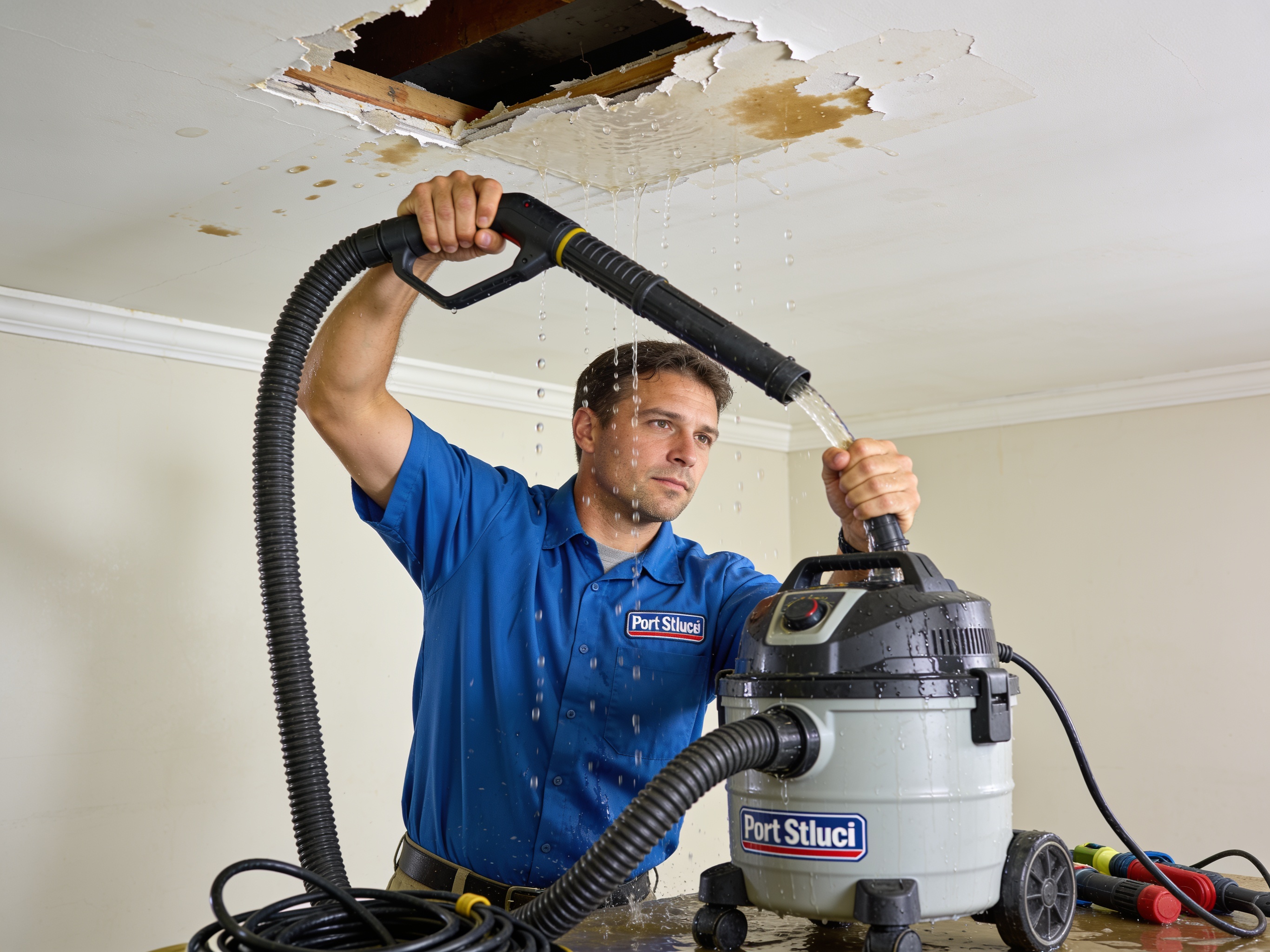
Ceiling water extraction in Port St. Lucie often involves single-story homes built from the 1980s through early 2000s with textured drywall and limited attic access. Water from roof penetrations or second-floor plumbing travels along joists before pooling, saturating both the drywall and any blown-in insulation above. Technicians must cut strategic access points while preserving structural integrity and avoiding electrical runs common in these older builds.
High humidity in St. Lucie County accelerates mold growth once drywall reaches saturation, especially during summer rains when outdoor moisture levels stay elevated for days. Flat lots near the St. Lucie River or in areas like St. Lucie West can direct runoff toward slab edges, pushing moisture upward into perimeter ceilings. Extraction requires negative air machines and moisture meters to confirm hidden pockets along seams and around recessed lighting.
After extraction, crews remove wet insulation and treat exposed framing before reinstalling new drywall. In hurricane season, multiple small leaks from wind-driven rain can appear across a single ceiling, requiring room-by-room mapping rather than one large cut. Homeowners in neighborhoods like Tradition or Sandpiper Bay frequently discover damage weeks later when stains appear, making early detection critical to limit replacement scope.
Technician insight
In Port St. Lucie, the thing that catches most people out with Ceiling Water Extraction is how quickly water travels along ceiling joists in 1980s-1990s homes with minimal attic ventilation. Homeowners often spot a small stain and assume it's contained, but by the time we arrive the saturation has spread ten feet in either direction because of our flat terrain and heavy afternoon rains.
St. Lucie West Roof Leak
A homeowner in St. Lucie West noticed a brown stain after summer rains. We mapped moisture across three joist bays and found saturated insulation above a bathroom ceiling. Extraction and insulation removal stopped further sagging, and the ceiling dried within four days without additional drywall replacement.
Ceiling Water Extraction Services We Offer
✓Drywall Ceiling Extraction
Remove saturated drywall sections and extract standing water from above to stop further sagging in Port St. Lucie homes.
✓Attic Insulation Extraction
Pull wet blown-in or batt insulation from ceiling cavities after leaks, preventing hidden mold in St. Lucie County attics.
✓Popcorn Ceiling Water Removal
Carefully extract water from textured popcorn ceilings common in 1990s Port St. Lucie homes without widespread demolition.
✓Post-Storm Ceiling Drying
Deploy drying equipment after hurricane-driven rain enters through roof vents or skylights in local single-story properties.
✓Recessed Light Leak Extraction
Address water trapped around recessed fixtures where moisture collects in Port St. Lucie ceiling assemblies.
Ceiling Water Extraction Cost in Florida
| Service | Typical Range | What Affects It |
|---|---|---|
| Small ceiling leak extraction | $450–$850 | Single room, limited access needed |
| Full room ceiling extraction | $900–$1,600 | Includes insulation removal and drying equipment |
| Multi-room or attic involvement | $1,800–$3,200 | Larger access cuts and extended drying time |
Ranges are typical for Florida and confirmed with an exact written quote before any work starts.
How it works
- 1
Initial Moisture Mapping
Use meters to trace water paths through ceilings in Port St. Lucie homes, identifying hidden saturation along joists and around fixtures.
- 2
Targeted Access Cuts
Make precise openings to reach trapped water while protecting electrical lines and minimizing visible repair areas.
- 3
Water Extraction and Insulation Removal
Remove standing water and saturated insulation, then apply antimicrobial treatment to exposed framing.
- 4
Drying and Monitoring
Run commercial air movers and dehumidifiers, checking daily moisture levels until readings return to normal for the local climate.
Pricing
Cost depends on ceiling access difficulty, square footage affected, and whether insulation removal is required.