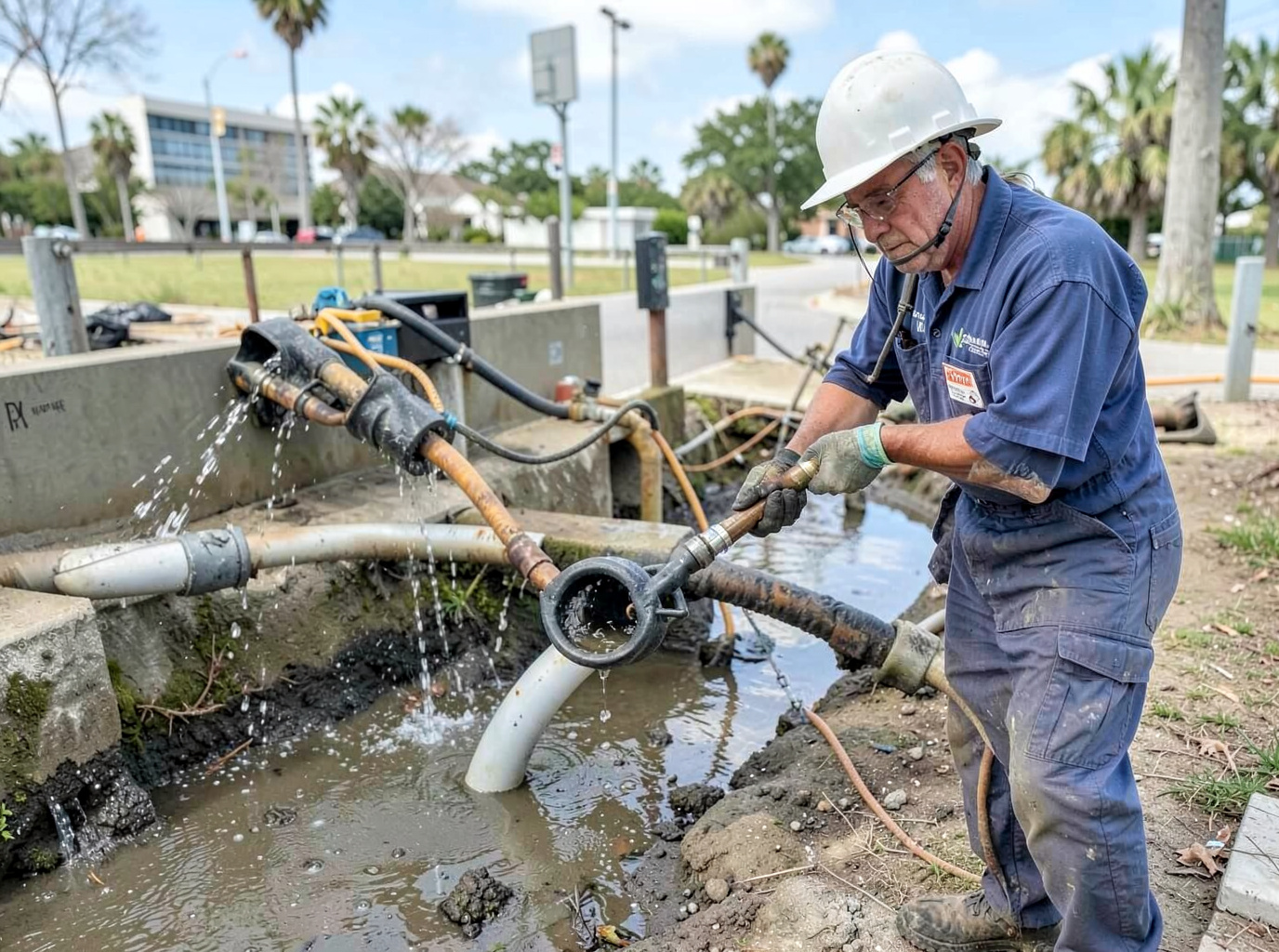
In St. Petersburg's older waterfront neighborhoods in Pinellas County, storm water extraction often targets homes with crawlspaces that flood during hurricane season when Tampa Bay surges combine with heavy rains. Crews navigate narrow streets off I-275 and US 19 where drainage backups send water into bungalows and mid-century houses near the Pier. Failures commonly hit flat roofs on commercial buildings around Tropicana Field or saturated yards in low-lying coastal zones.
Storm Water Extraction in St. Petersburg — What We Handle
- ✓Work here contends with salt-water intrusion from bay surges unlike inland Florida sites.
- ✓Narrow historic streets limit equipment access compared to newer subdivisions.
- ✓Frequent afternoon thunderstorms demand rapid response before secondary mold sets in.
Port St. Lucie homes built on slab foundations over sandy soil and a high water table face rapid under-slab flooding once tropical storms drop several inches in a few hours. Water moves laterally through the sand and enters at expansion joints, utility penetrations, and garage door thresholds. Extraction crews must locate these entry points quickly because standing water under the slab can wick moisture into drywall and base cabinets within 48 hours in the local humidity.
After major rain events, many neighborhoods east of the Turnpike and near the North Fork of the St. Lucie River see water pond against rear property lines where fill dirt has settled. Portable gas-powered pumps with 2-inch and 3-inch hoses are staged at low points while crews monitor discharge routes to avoid sending water into neighboring yards or storm drains already at capacity. In older sections of the city with 1980s and 1990s construction, crews also check for buried downspout extensions that have collapsed and now funnel roof runoff directly against the foundation.
How It Works in St. Petersburg
- 1
Site Assessment
Technicians walk the property to identify water entry points, measure depth, and check for electrical hazards before equipment is brought in.
- 2
Bulk Water Removal
High-capacity pumps and wet vacs extract standing water from floors, garages, and yards while directing discharge to safe locations.
- 3
Moisture Mapping
Infrared and pin meters locate hidden saturation under flooring and along walls so drying can target the actual affected zones.
- 4
Drying And Monitoring
Air movers and dehumidifiers are positioned and checked daily until moisture readings return to normal levels for the local climate.
Storm Water Extraction Services We Offer in St. Petersburg
✓Hurricane Flood Extraction
Rapid removal of several inches of standing water from living areas after named storms using high-volume pumps and wet vacuums suited to Port St. Lucie slab homes.
✓Post-Storm Crawl Space Pumping
Clearing water from vented crawl spaces common in older Port St. Lucie neighborhoods where the water table rises during prolonged rainy periods.
✓Garage and Threshold Water Removal
Extracting water that enters at garage doors and sliding glass thresholds, a frequent issue in homes east of US-1 after afternoon thunderstorms.
✓Yard Drainage After Heavy Rain
Pumping ponded water from low-lying yards and swales in areas like Tradition and St. Lucie West before it migrates toward foundations.
✓Slab Edge Water Extraction
Targeted removal along slab perimeters where sandy soil allows storm water to migrate under the concrete in many 1990s Port St. Lucie subdivisions.
Serving All of St. Petersburg
We regularly handle storm water extraction jobs near:
- 📍The Dalí Museum
- 📍Sunken Gardens
- 📍St. Pete Pier
- 📍Tropicana Field
- 📍Vinoy Park
- 📍Mirror Lake
Storm Water Extraction Pricing in St. Petersburg
Cost depends on water volume, number of rooms affected, and whether access requires pumps through windows or doors.
Want the full picture of this service? See our Storm Water Extraction page, or everything we do in St. Petersburg, FL.